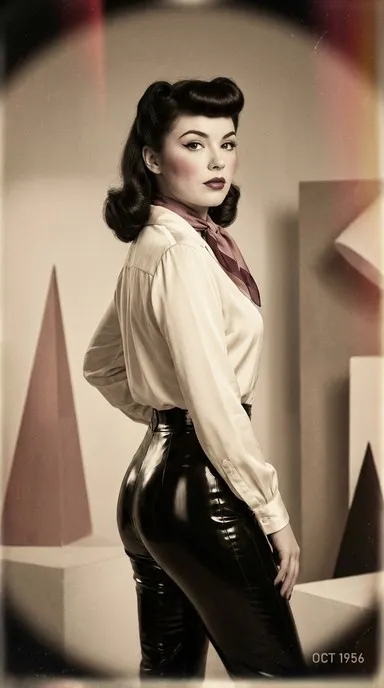
Before You Step in Front of the Lens: Real Talk from Pin-Up Models Who've Been There
Let's be honest: no amount of Pinterest mood boards fully prepares you for the moment you're standing in front of a photographer's backdrop in your best vintage-inspired set, wondering what to do with your hands. Every model who's been in this industry for any length of time remembers that feeling — the mix of excitement and self-consciousness that comes with being truly seen for the first time through a professional lens.
The good news? The pin-up community has a reputation for being one of the most welcoming, encouraging spaces in all of modeling. The even better news? The women who've been doing this for years are pretty generous about sharing what they know. We reached out to a group of established pin-up models from across the US and asked them the question they wish someone had asked them earlier: what do you know now that you really needed to know then?
Here's what they said.
Preparation Is Everything (and It Starts Way Before Shoot Day)
The single most consistent piece of advice? Do your homework before you ever show up to a studio.
"I spent my first shoot completely in my head because I hadn't done any real prep," admits one model based out of Nashville who has since built a following of tens of thousands across her social platforms. "I didn't know what poses I wanted to try, I hadn't really studied the style, and I definitely hadn't thought about what made me feel good versus what I thought I was supposed to look like. I was performing someone else's idea of pin-up instead of my own."
Practical preparation means different things to different people, but a few things came up again and again. Study the work of photographers whose aesthetic resonates with you. Practice poses in front of a full-length mirror — yes, actually do this, even if it feels ridiculous. Get comfortable with your wardrobe choices days before the shoot so you're not second-guessing a fit or a silhouette when you're already on set. And sleep. Seriously, sleep.
Skin prep matters too, though the models we spoke to were quick to note that "prep" doesn't mean "fix." Staying hydrated, moisturizing consistently in the week before a shoot, and avoiding anything that might cause unexpected skin reactions are all solid habits. But the goal is to show up as the best version of yourself, not a filtered approximation of someone else.
Communication Is Your Most Important Tool
If there's one thing that separates a great shoot experience from a mediocre one, it's communication — and it needs to happen before, during, and after you're in front of the camera.
Before the shoot, be clear about what you're comfortable with. This isn't just about content level; it's about everything from which body parts you prefer not to emphasize, to whether you're okay with the photographer adjusting your pose physically, to how you handle direction when you're feeling uncertain. A good photographer will ask these questions. But don't wait to be asked.
"I learned really early that no photographer can read your mind," says a model from Phoenix who specializes in classic 1950s-style pin-up. "If something doesn't feel right — a pose, a lighting setup, the vibe in the room — you have to say something. The best shoots I've ever done were the ones where the photographer and I were basically having a conversation the whole time. The worst ones were the ones where I just smiled and went along with things I wasn't sure about."
During the shoot, check in with yourself regularly. It's easy to get caught up in the momentum of a session and push past your own comfort zone without realizing it. You're allowed to take breaks. You're allowed to say "can we try something different?" You're allowed to look at the images mid-shoot if that helps you relax and calibrate.
The Body Confidence Question
This is the one that comes up most often, and it's the one where the models we spoke to had the most to say.
Pin-up culture has a complicated history with body image. The classic aesthetic was built around a very specific silhouette — one that, by today's standards, was actually more inclusive of curves than the ultra-thin ideal that dominated modeling through the 80s and 90s. But it still represented a narrow range of bodies, and the pressure to fit a particular mold is something many models have felt acutely.
What's changed in recent years is significant. The contemporary American pin-up scene is genuinely more diverse than it's ever been, with models of all sizes, ages, skin tones, and backgrounds finding both audiences and community. But the internal work — the process of actually feeling comfortable and confident in your own body in front of a camera — that's something every model has to navigate for herself.
"I used to spend so much energy trying to hide the parts of myself I thought were wrong," reflects one plus-size model from Chicago who has been shooting pin-up for six years. "And then one day a photographer pointed out that the things I was trying to hide were actually the things that made my images interesting. The curve of a hip. The softness of a stomach. These aren't flaws to be minimized — they're the whole point."
The advice that comes up most consistently: stop shooting for the body you think you're supposed to have and start shooting for the body you actually live in. The images that resonate most — the ones that get shared, that build careers, that make people feel something — are almost always the ones where the model looks genuinely at home in her own skin.
Building a Portfolio That Actually Opens Doors
A few practical notes on the business side of things, because this is a real industry and it helps to treat it like one.
Your first few shoots probably shouldn't be paid work — and that's okay. Building a portfolio through collaborative shoots (often called TFP, or trade for portfolio) with photographers whose work you admire is a smart way to develop your range without the pressure of a paid booking. Be selective about who you work with. A few strong, cohesive images from photographers with a clear aesthetic will do more for your career than a sprawling collection of inconsistent work.
Think about your brand early. What makes your take on pin-up distinct? What era, what vibe, what feeling do you want people to associate with your name? The models who build real longevity in this space are almost always the ones who have a clear sense of who they are as a subject and a performer — and who communicate that consistently across their portfolio and their social presence.
And finally: find your people. The pin-up community, at its best, is genuinely collaborative and supportive. Other models are not your competition. They're your colleagues, your collaborators, and often your biggest champions. Show up for them and they'll show up for you.
The first shoot is just the beginning. But if you go in prepared, communicative, and — as much as possible — at peace with the body you're bringing to the session, you're already ahead of where most people start.