Glamour as Protest: Why Pin-Up Is the Most Subversive Thing You Can Do Right Now
Photo: puuikibeach, CC BY 2.0, via Wikimedia Commons
Here's something nobody tells you when you first discover pin-up: putting on a full face of victory rolls, a bullet bra, and a cherry-red lip in 2024 is, objectively, a more rebellious act than it was in 1955.
That sounds backward. The 1950s were the era of the original Bettie Page, the Vargas Girl, the Elvgren calendar hanging in every auto shop from Tulsa to Tacoma. Pin-up was mainstream then — mass-produced, commercially distributed, and thoroughly approved by the same culture that told women to smile and serve dinner by six. So how did something that was once the aesthetic of conformity become, decades later, a form of quiet defiance?
The answer has everything to do with what we're rebelling against.
The New Conformity Looks a Lot Like Sweatpants
American style in the 2020s has settled into a strange kind of uniformity. The dominant aesthetic is aggressively casual — oversized hoodies, leggings worn as pants, sneakers with everything. On social media, the look is either hyper-filtered perfection or ostentatiously "real" in a way that's been carefully staged to appear effortless. Either way, the underlying message is the same: don't try too hard.
Trying too hard is the modern sin. Effort is embarrassing. Glamour, especially the theatrical, unapologetically feminine kind, reads as naive at best and politically suspect at worst.
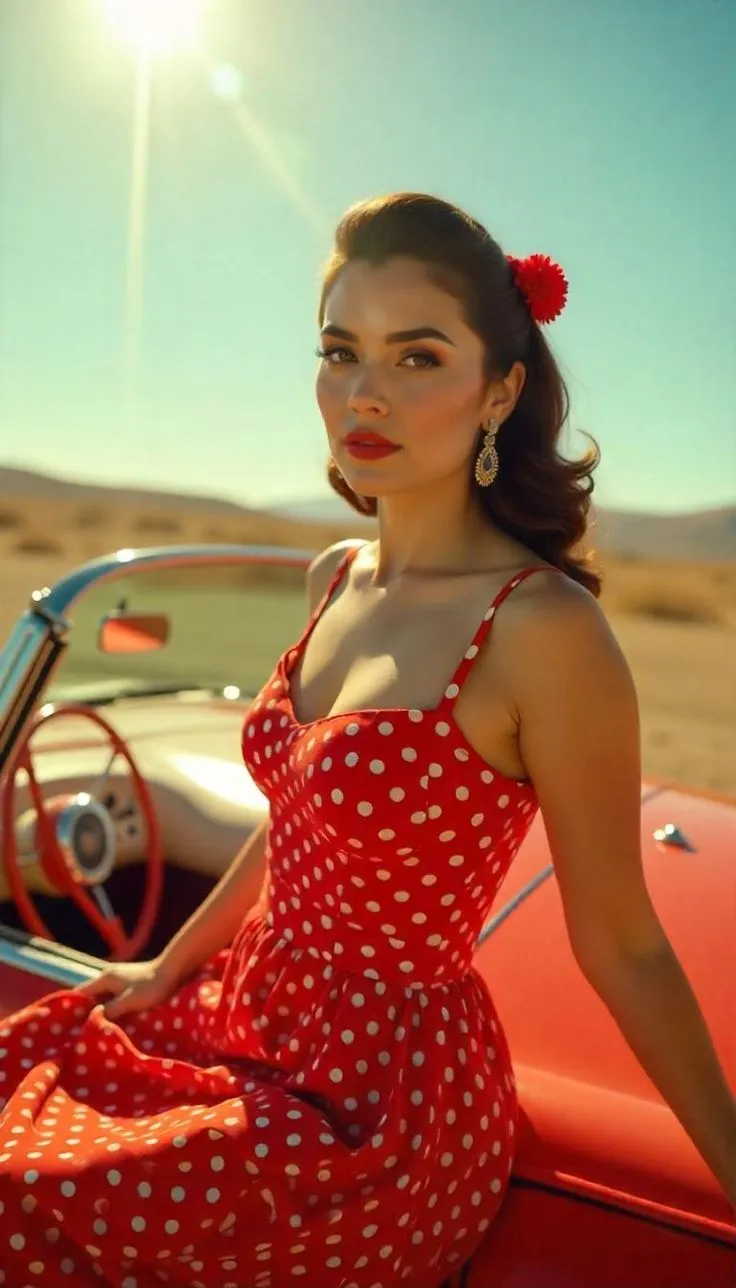
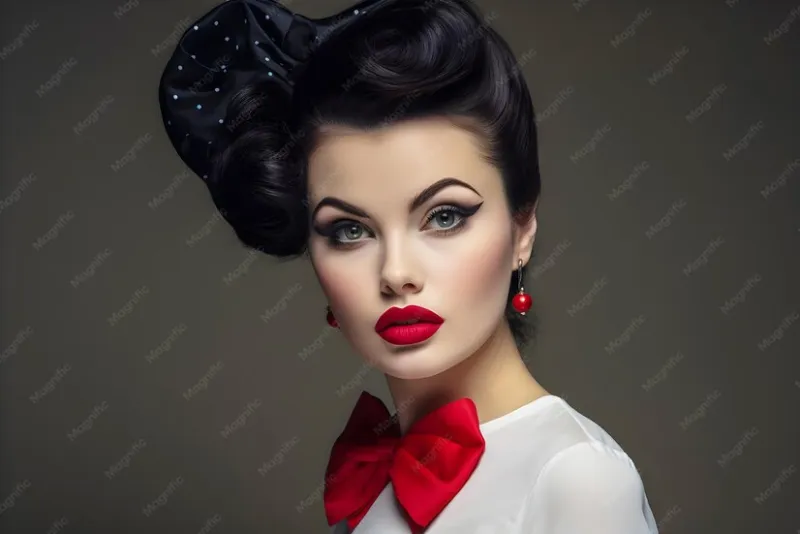
Into this environment walks a woman in a circle skirt, seamed stockings, and a set wave. She is immediately, undeniably doing something on purpose.
"There's this assumption that dressing down means you're liberated and dressing up means you're performing for somebody else," says Margaux Delacroix, a New Orleans-based pin-up model and vintage enthusiast who's been shooting for almost a decade. "But I'd argue it's the opposite. When I put on a full pin-up look, I'm performing for myself. The effort is the point. It's saying I think I'm worth the time."
Deliberate Femininity in the Age of the Algorithm
Social media has done something strange to beauty culture. It has simultaneously democratized it and flattened it. Filters homogenize faces. Trends move in micro-cycles that reward whoever chases them fastest. The result is a landscape where individual aesthetic identity gets harder and harder to maintain.
Pin-up resists this by its very nature. The look is labor-intensive, highly specific, and deeply rooted in a visual tradition that predates Instagram by about a century. You can't slap a preset on it and call it a day. The cat-eye has to actually be even. The curl has to actually hold. The posing has to actually communicate something.
"Pin-up is one of the few aesthetics left that genuinely punishes shortcuts," says Dallas-based photographer Remy Okafor, who's been shooting retro-inspired content for seven years. "And weirdly, that's why people are drawn to it right now. There's a hunger for things that take real skill and real intention. People are tired of everything looking like it came from the same content farm."
Okafor points out that his bookings have shifted meaningfully in the last three years. More of his clients are coming in specifically because they want something that looks handmade and human — not despite the theatricality of pin-up, but because of it.
The Reclamation Nobody Talks About
Feminist critique of pin-up has a long history, and it's not wrong. The original genre was largely produced by men, for men, and it existed within a cultural framework that offered women very little agency over their own image. That's real, and it matters.
But something interesting has happened in the decades since second-wave feminism first took aim at the Vargas Girl. Women have moved into the center of pin-up culture — as photographers, as directors, as models who control their own platforms and their own revenue. The aesthetics are the same. The power dynamics have shifted dramatically.
"My grandmother would have been horrified that I do this," admits Chicago model and content creator Stella Vance, laughing. "Not because of the skin or the poses, but because she associated that look with being someone's object. She didn't have the option to own it. I do. That's the whole difference."
Cultural critic and writer Danielle Foss, who covers gender and aesthetics for several independent publications, frames it this way: "What we're seeing with contemporary pin-up is a kind of aesthetic reclamation that the original subjects of the genre never got to participate in. The imagery is being reproduced, but the relationship to it is completely transformed. Women are choosing it, producing it, and profiting from it. That's not the 1950s. That's something new using old clothes."
Why "Too Much" Is Exactly Enough
One of the most consistent things you hear from women who shoot pin-up — especially those who come to it as adults, after years of being told to minimize themselves — is that the experience of being deliberately, unapologetically visible is genuinely disorienting at first.
American women are socialized, in ways both obvious and subtle, to take up less space. Speak more quietly. Dress more neutrally. Age more gracefully. Pin-up runs directly counter to every one of those instructions. It is loud, it is maximalist, and it is completely uninterested in disappearing.
"The first time I did a full pin-up shoot, I cried in the parking lot afterward," says Margaux. "Not sad crying. Just — I didn't know what to do with having been that visible for three hours. It felt like something I wasn't supposed to have."
That feeling — the particular vertigo of claiming space you've been quietly trained to avoid — is part of what gives contemporary pin-up its edge. It's not just nostalgia. It's not just pretty pictures. It's a confrontation with a set of rules most women didn't even know they'd internalized.
The Paradox, Resolved
So here's the thing about the pin-up paradox: it's not really a paradox at all, once you look at it straight.
In the 1950s, pin-up was the mainstream. It was what the culture produced and consumed without much friction. Today, it sits in direct opposition to dominant aesthetics — the casual, the algorithmic, the effortlessly unpolished. It requires skill, intention, and a willingness to be visibly, theatrically feminine in an era that treats that as either frivolous or regressive.
That's not a contradiction. That's just what happens when culture moves on and leaves something behind — sometimes the thing it left behind turns out to be exactly the thing people needed to find again.
Pin-up in 2024 isn't retro. It's a statement. And the fact that it's wrapped in seamed stockings and a victory roll makes it land harder, not softer.
Welcome to the resistance. The lipstick is red, and the curl is set.