Feeling Good in the Frame: The Real Reason Pin-Up Models Outshine Fashion's Confidence Game
There's a version of modeling that chews people up and spits them out. You've heard the stories — the casting directors who hand out index cards with target weights written on them, the stylists who talk about a model's body like she's not standing right there, the relentless pressure to shrink, smooth, and disappear into whatever the clothes need her to be. That's the traditional fashion world for a lot of women, and honestly, it's been that way for decades.
Then there's pin-up. And something wildly different is going on over here.
Models who've worked in both spaces — or who've made the jump from one to the other — consistently report that pin-up photography does something to their self-image that conventional fashion work simply doesn't. They feel seen. They feel creative. They feel, in a word that sounds almost too simple, good. So what's actually driving that difference? Let's get into it.
The Perfectionism Trap in Traditional Fashion
High fashion has always had a complicated relationship with the human body. The industry's historical preference for extremely thin frames wasn't accidental — it was a design philosophy, the idea that models should function as neutral hangers for clothing rather than as fully realized people. And while there's been some meaningful progress in recent years, the underlying culture of perfectionism hasn't gone anywhere.
Models working in that world often describe a psychological dynamic that's hard to shake: you're constantly being evaluated against an external standard that has nothing to do with you as a person. Your measurements get checked. Your skin gets scrutinized. Your face gets compared to whoever booked the last campaign. The feedback loop is relentless, and it trains you to see your body as a problem to be managed rather than something that belongs to you.
Psychologists have a name for this pattern — objectification theory — and the research behind it is pretty sobering. When people are repeatedly treated as objects to be assessed rather than subjects with their own inner lives, they start to internalize that external gaze. They begin monitoring their own appearance the way a critic would, which tends to erode body satisfaction and self-worth over time.
That's the trap. And a lot of traditional models walk right into it, often without realizing it's happening.
Why Pin-Up Flips the Script
Pin-up photography operates on a fundamentally different set of assumptions, and those assumptions matter more than most people realize.
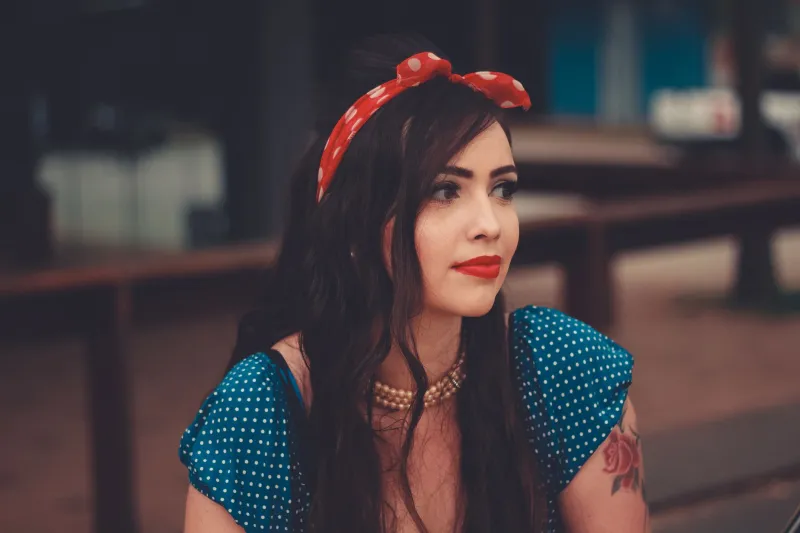
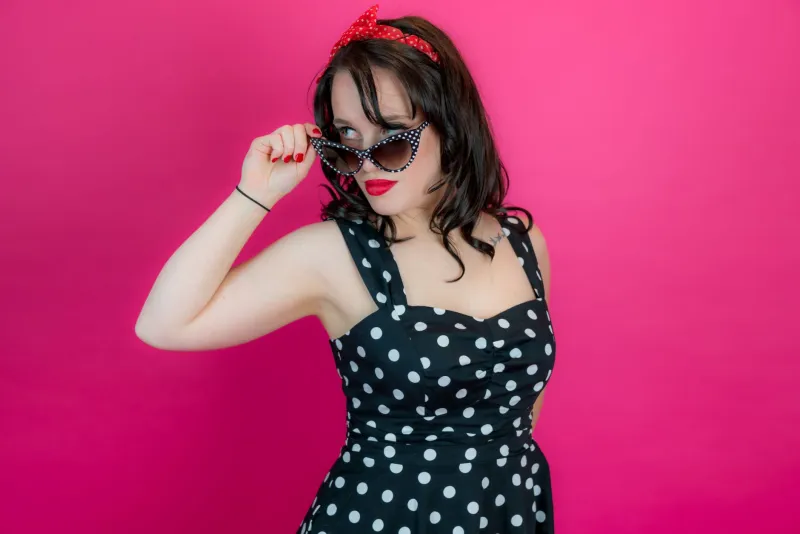
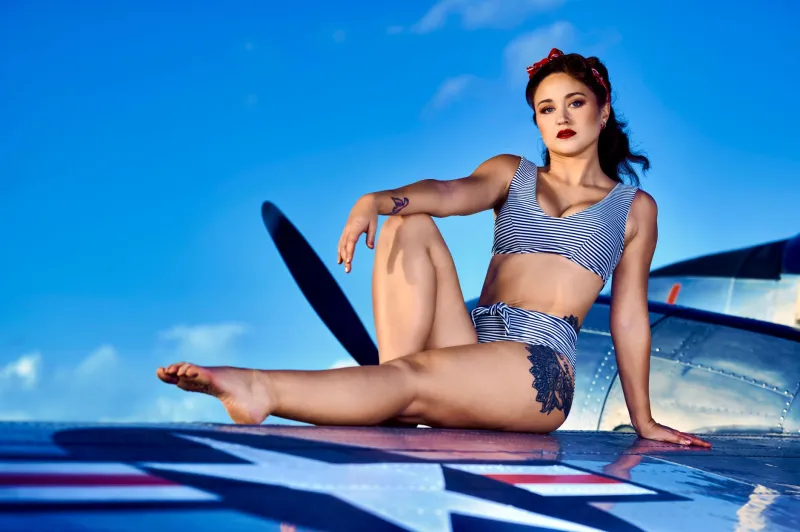
For starters, the whole aesthetic is built around celebrating the body rather than neutralizing it. The curvy silhouettes, the exaggerated poses, the playful expressions — none of that works if the model disappears into the background. Pin-up needs her to be present, specific, and fully herself. That's not just a stylistic choice. It's a structural shift in how the model's body and personality are valued.
Models who've transitioned from conventional work to pin-up shoots often describe the experience as disorienting at first — in a good way. "I kept waiting for someone to tell me to tone something down or cover something up," one model who'd done catalog work for several years told us. "Instead, the photographer kept asking what I wanted to bring to the shot. It took me a while to even understand the question."
That creative collaboration is a big part of what makes pin-up different. Unlike fashion shoots where models are often given precise direction and expected to execute it with minimal input, pin-up shoots tend to be genuinely collaborative. Models help choose their looks, contribute ideas about posing and expression, and often have real creative ownership over the final images. That sense of agency — of being a co-creator rather than a subject — has measurable effects on how people feel about themselves.
Body Diversity Isn't a Trend Here, It's the Whole Point
One of the most consistent things you hear from pin-up models is that the community actually means it when it talks about body inclusivity. This isn't a PR talking point or a diversity initiative rolled out to generate good press. The pin-up aesthetic has always encompassed a wide range of body types, and that history gives the current community a kind of built-in credibility that newer body-positive movements sometimes struggle to establish.
When a size-14 model books a pin-up shoot, she's not being positioned as a statement or a departure from the norm. She's just doing pin-up. The visual language of the genre — the emphasis on curves, the celebration of femininity in all its variations — genuinely accommodates her in a way that a lot of other modeling contexts don't.
This matters psychologically because representation isn't just about seeing yourself in images. It's about understanding that the space was built with you in mind. There's a difference between being tolerated and being welcomed, and most pin-up models will tell you they feel the latter.
Community as a Confidence Multiplier
Here's something the fashion industry doesn't talk about much: modeling can be incredibly isolating. You're in competition with everyone around you, the work is often solitary, and the culture doesn't exactly encourage vulnerability or mutual support.
Pin-up culture is almost the opposite. The community that's grown up around this aesthetic — at conventions, in online spaces, through local shooting groups and vintage style clubs — is genuinely supportive in ways that can feel almost startling if you're coming from a more competitive modeling background. Models share resources, celebrate each other's bookings, and mentor newcomers with a generosity that's pretty rare in any creative industry.
That community scaffolding does real work for self-esteem. Having people around you who are rooting for your success, who share your aesthetic values, and who see your specific look as something worth celebrating — that's not a small thing. It creates a feedback loop that runs in the opposite direction from the objectification trap: instead of learning to see yourself as a problem, you start learning to see yourself as someone worth showing up for.
What This Tells Us About Confidence More Broadly
The pin-up world isn't perfect. Like any creative industry, it has its gatekeepers, its politics, and its occasional difficult personalities. But the structural differences between pin-up modeling and conventional fashion work — the collaborative creative process, the body-inclusive visual language, the community orientation — add up to something that genuinely shifts how models experience themselves.
And that's worth paying attention to, not just as a fun fact about a niche modeling genre, but as a case study in what actually builds confidence. Turns out it's not about being told you're beautiful enough to fit a standard. It's about being part of a creative process that treats your specific self — your body, your personality, your ideas — as the whole point.
Pin-up figured that out a long time ago. The rest of the industry is still catching up.