More Than Eye Contact: The Emotional Chemistry That Makes Pin-Up Photography Feel So Personal
Something happens when you look at a great pin-up photograph. You don't just see a beautiful person. You feel like they see you right back. That's not an accident, and it's not just good lighting. It's the result of a very specific kind of creative relationship — one that separates pin-up from almost every other genre of photography out there.
High fashion shoots can be cold. Commercial work can be transactional. But pin-up, at its best, is something else entirely. It's intimate. It's theatrical. And it's built on a kind of emotional intelligence that most people never stop to think about.
The Pose Is a Performance, Not a Position
In conventional modeling, the body is often treated like a hanger — something to display a product, a garment, or a concept. The model's inner life is largely beside the point. The goal is clean lines, sellable aesthetics, and brand alignment.
Pin-up flips that entirely.
Every arch of the back, every over-the-shoulder glance, every playful tug at a stocking is a choice — a piece of visual storytelling that only works when the model is genuinely in on the joke, the mood, the moment. You can't fake that. Viewers can always tell when a pin-up pose is technically correct but emotionally hollow. It reads like a copy of a copy.
"The difference between a pin-up that lands and one that falls flat usually comes down to whether the model and I actually talked before we shot anything," says Marcus Delray, a Chicago-based photographer who's been shooting pin-up and retro-glamour work for over a decade. "I need to know what makes her laugh, what makes her feel powerful, what version of herself she wants to show the world. That stuff is the whole shoot."
That kind of pre-shoot conversation is standard practice in serious pin-up work. It's not small talk — it's the foundation.
Why the Viewer Feels It
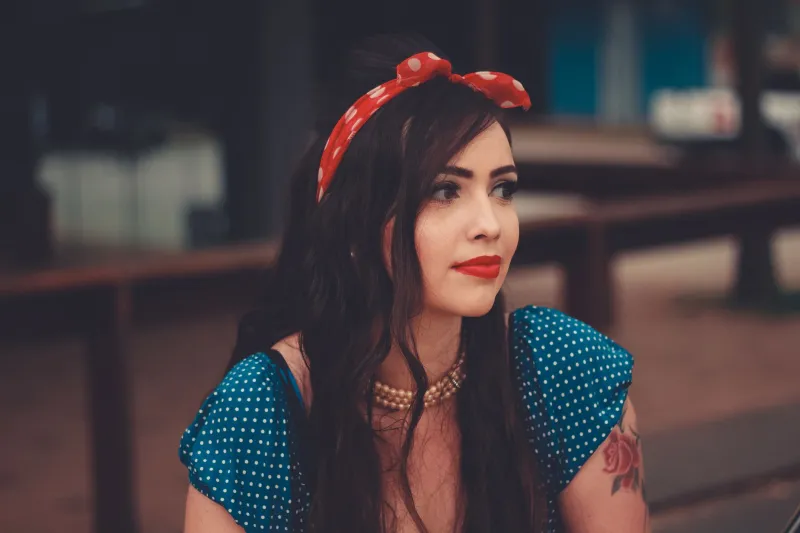
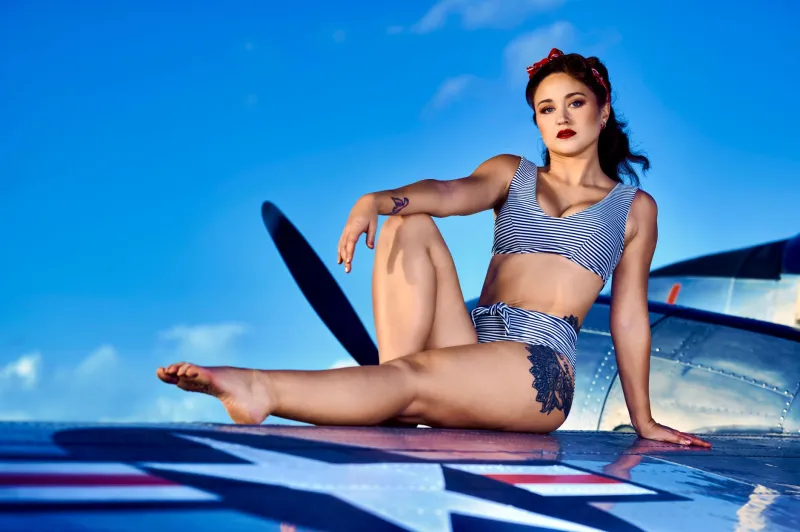
There's a reason pin-up imagery has always felt more present than a lot of other photography. Part of it is the direct gaze — that unapologetic look into the camera that says I know you're watching, and I'm choosing to let you. That's a very different energy from a model staring into the middle distance or a fashion editorial where eye contact is deliberately avoided to maintain an air of aloofness.
Pin-up invites the viewer in. It creates a triangle of connection: the photographer who shaped the vision, the model who embodied it, and the person looking at the finished image who gets to feel, even briefly, like they're part of something.
Psychologically, this is significant. Research on parasocial connection — the phenomenon where audiences feel genuine relationships with people they've never met — consistently points to eye contact, warmth, and perceived intentionality as key triggers. Pin-up hits all three. The subject isn't ignoring you. She's performing for you, and she's doing it with full awareness and genuine enthusiasm.
"It's almost theatrical in the best way," says Joelle Tanner, an emerging pin-up model based in Nashville who started shooting about two years ago. "When I'm in character — when the hair and the outfit and the whole vibe clicks — I'm not just posing. I'm communicating. And I can feel when the photographer is receiving it. That feedback loop is what makes the images feel alive."
The Photographer's Role Is Different Here
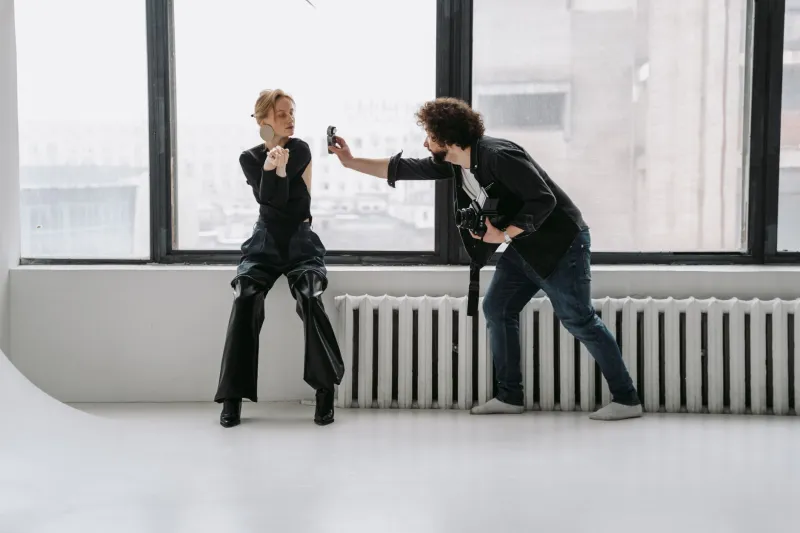
In high-fashion work, the photographer is often the dominant creative force. The model executes a vision. In pin-up, the dynamic tends to be far more collaborative — and experienced pin-up photographers will tell you that's not just a philosophical preference. It's a practical necessity.
Because pin-up relies so heavily on the model's authentic energy, a photographer who simply directs without listening will consistently produce flat work. The best pin-up images are co-created. The model brings something to the table that can't be scripted — her personality, her humor, her specific brand of confidence — and the photographer's job is to create the conditions where that thing can fully show up.
"I always tell new models that I'm not here to capture what you look like," says Delray. "I'm here to capture who you are on a really good day. My job is to make that day happen in the studio."
That requires emotional intelligence on the photographer's side — the ability to read the room, adjust the energy, know when to crack a joke and when to go quiet and just let the model find her moment. It's a skill set that doesn't show up in most photography courses, but it's arguably more important than knowing your f-stops.
Mutual Respect as a Creative Tool
One of the things that distinguishes healthy pin-up culture from more exploitative corners of adult photography is the degree to which respect functions as an actual creative ingredient. When a model feels safe, seen, and genuinely in control of her own image, that security shows up in the work. Her posture is different. Her expression is different. The whole photograph breathes differently.
This is something the pin-up community has understood intuitively for a long time, even before anyone had the language to articulate it. The classic pin-up artists — Vargas, Elvgren, Petty — weren't just painting beautiful women. They were painting women who looked like they were having the time of their lives. That joy, that ease, that sense of total ownership over the moment — it's the whole point.
Modern pin-up photography carries that forward. And the models who thrive in this space are almost universally the ones who've found photographers they genuinely trust — people who treat the shoot as a conversation rather than a transaction.
"I've done shoots where I felt like a prop," Tanner admits. "And I've done shoots where I felt like a co-author. The images from the second kind of shoot? You can tell the difference immediately. There's a life in them that the other ones just don't have."
Why This Matters Beyond the Frame
It's easy to look at pin-up photography and see only the surface — the vintage aesthetics, the dramatic makeup, the playful poses. But what's actually happening in the best of this work is something more meaningful: two people (at minimum) showing up fully, trusting each other, and making something together that neither could have made alone.
That's not a small thing. In a media landscape that's increasingly driven by algorithmic detachment and filtered unreality, the deliberate, human intimacy of pin-up photography stands out. It doesn't just look different. It feels different.
And that feeling — that sense of being genuinely seen, both as a model and as a viewer — is exactly why this art form keeps pulling people in, generation after generation.